Titanium alloys, especially Ti-6Al-4V (TC4), are often called “space-age metals” or “marine metals.” Thanks to their excellent strength-to-weight ratio, outstanding corrosion resistance, and great biocompatibility, they’ve become a go-to material for top-tier manufacturing.
Even though machining titanium can be tricky and expensive, it’s the only choice for applications where performance, reliability, and longevity are absolutely critical.
This guide will walk you through the seven key areas where precision-machined titanium parts are making a difference.
We won’t just talk about why it’s used, but also why it’s hard to work with and how advanced manufacturing overcomes these hurdles.
Let’s see how this material is pushing the boundaries in everything from aircraft and medical tech to the latest humanoid robots.
Key Takeaways:
In aerospace, every gram saved translates to lower costs and better performance. Titanium isn’t just an “option” here—it’s an essential enabler for flight. Its uses fall into three main categories:
Typical Parts: Fuselage frames, wing spars, bulkheads, landing gear struts, and bearings.
Why It’s Great: Using titanium in the airframe is a textbook example of “lightweighting.” Titanium is about 60% the density of steel but just as strong.
This significant weight reduction means:
For high-impact parts like landing gear, titanium’s strength, toughness, and resistance to corrosion fatigue ensure top-notch safety and reliability.
Real-World Example: Portions of the Boeing 787 and Airbus A350 fuselage and wing spars use Ti-6Al-4V.
Machining Insight: Suppliers in China’s Yangtze and Pearl River Delta regions are increasingly using titanium components for domestic commercial aircraft and drone projects. When machining large frames, controlling heat-induced distortion and stress is key. Using rigid 5-axis machines with high-pressure coolant is essential for maintaining the precision and surface integrity of large, thin-walled parts.
Typical Parts: Fan and compressor blades, turbine disks, engine casings, nozzle actuators.
Why It’s Great: Titanium shines in engines due to its high strength-to-weight ratio and heat stability. It can make up 25-30% of a modern jet engine’s weight, playing a huge role in improving thrust-to-weight ratios.
Front Section (Fan/Compressor): Titanium blades stay dimensionally stable at high speeds and resist foreign object damage.
Core Section: Alloys like Ti-6Al-4V maintain their strength in medium-high temperatures (300-500°C), where aluminum would fail.
Machining Insight: Blade profiles and air channels require extremely precise contours and smooth finishes. Multi-axis milling and specialized blisk machining centers are crucial, using tools with heat-resistant coatings.
Typical Parts: High-strength bolts, screws, retaining rings, lock washers.
Why It’s Great: These small parts are vital for structural integrity.
High Strength-to-Weight: Titanium fasteners are lighter than steel ones providing the same clamping force.
Superior Corrosion Resistance: They don’t cause galvanic corrosion when in contact with carbon fiber composites, making them ideal for joining composite parts.
Thermal Expansion Match: Their expansion rate is closer to composites, reducing stress during temperature cycles.
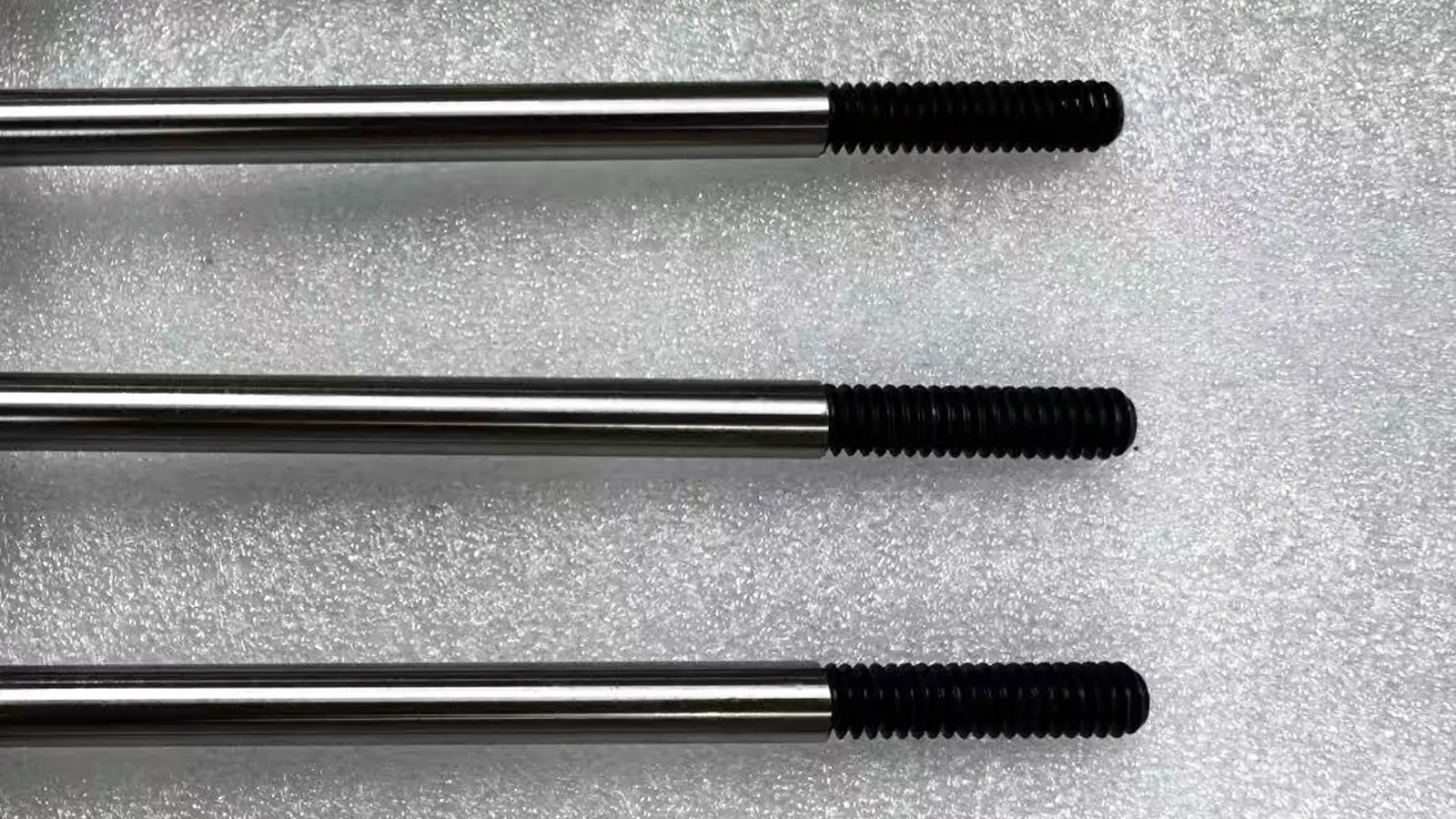
Machining Insight: The fatigue strength of threads is critical. Precision turn-mill machining ensures smooth, defect-free thread roots, and subsequent rolling processes can further enhance fatigue life.
Industry Trend: Titanium is now being combined with Additive Manufacturing (3D Printing). Technologies like Laser Powder Bed Fusion (LPBF) can create complex, lightweight, single-piece structures—like housings with internal conformal cooling channels—that are impossible with traditional machining, taking aerospace performance to new levels.
Titanium alloys (especially Ti-6Al-4V ELI) are widely used in the medical industry due to their excellent biocompatibility, corrosion resistance, and mechanical properties, serving in implants, surgical tools, and equipment.
Typical Uses: Artificial joints (hip, knee, shoulder, ankle), trauma & spinal products (plates, screws, cages), cranial plates, dental implants.
Why It’s Great:
Biocompatibility: Titanium forms a stable, inert oxide layer that minimizes metal ion release and rejection, allowing bone to fuse with it directly (“osseointegration”).
Ideal Mechanical Properties: Its elastic modulus is closer to bone than stainless steel or cobalt-chrome, reducing “stress shielding” and bone loss around the implant.
Imaging Compatibility: It’s non-magnetic, so patients can safely undergo MRI scans after implantation.
Machining Insight: The surface roughness (Ra value) where the implant contacts bone is key for healing. Precision 5-axis machining followed by surface treatments (like sandblasting, acid etching, or plasma-sprayed hydroxyapatite coating) promotes faster and stronger bone integration.
Typical Uses: Minimally invasive tools (endoscopic graspers, cannulas), needle holders, scissors, orthopedic tool handles, robotic surgical arm components.
Why It’s Great:
Lightweight & Fatigue-Resistant: Reduces hand fatigue for surgeons during long procedures, improving precision.
Durable & Corrosion-Resistant: Withstands harsh sterilization methods (autoclave, gamma radiation, EtO) without degrading.
Low Thermal Conductivity: Provides better heat isolation during electrosurgery, protecting the surgeon’s hand.
Typical Uses: Lightweight moving parts for CT/MRI scanners (gimbals, brackets), surgical robot frames, ventilator/anaesthesia machine modules, portable ultrasound probe housings.
Why It’s Great:
Non-Magnetic: Causes zero interference in sensitive imaging equipment like MRI.
High Stiffness, Low Density: Provides necessary rigidity for high-speed, precise moving parts while reducing inertia for faster response.
Long-Term Stability: Resists corrosion from disinfectants and bodily fluids, ensuring reliable performance.
Industry Trend: 3D Printing is revolutionizing medical titanium use. Patient-specific, porous implants printed from CT data mimic bone structure for a perfect fit and encourage tissue in-growth, unifying biomechanics and biology.
Titanium is used in high-performance cars and racing primarily for its strength-to-weight ratio, fatigue resistance, and heat tolerance, which sharpen power response and handling.
Typical Uses: Connecting rods, valves, valve spring retainers, turbocharger blades and shafts, lightweight flywheel bolts.
Why It’s Great:
Reduces Reciprocating Mass: Lighter parts like rods and valves mean lower inertia, quicker engine revving (better throttle response), and the potential for higher, safer RPM limits.
Heat & Creep Resistance: In hot zones like turbochargers and exhaust valves (600°C+), titanium retains strength and resists deformation under long-term heat (“creep”).
Machining Insight: Connecting rods demand precise bore alignment, roundness, and surface hardness. Honing and laser engraving are common finishing steps.
Typical Uses: Suspension springs, pushrods, tie rods, wheel bolts, various lightweight brackets (knuckles, strut tops), anti-roll bar links.
Why It’s Great: Maximizes the “unsprung weight” reduction multiplier. Reducing weight in components below the spring (wheels, brakes, suspension parts) has a dramatic effect on handling—1kg saved here can feel like 5-15kg saved in the body. Benefits include:
Faster suspension response and better tire contact.
Sharper, more precise steering.
Improved braking performance.
Machining Insight: These safety-critical parts require supreme fatigue strength. Stress-controlled machining and 100% non-destructive testing (e.g., fluorescent penetrant inspection) are mandatory.
Typical Uses: Full or partial exhaust systems (headers, mid-pipes, mufflers), exhaust manifolds, heat shields.
Why It’s Great:
Lightweight: A titanium exhaust is about 40% lighter than a stainless steel one.
Corrosion Resistant: Withstands acidic exhaust condensate and high-temperature oxidation far better than stainless steel.
Thermal Management: Lower thermal conductivity helps maintain exhaust gas temperature and flow, potentially improving efficiency, while also protecting nearby parts from heat.
In Summary for Autos:
Titanium has moved from being an F1 staple to a feature in top-tier supercars and performance aftermarkets. It represents the ultimate engineering ethos: sparing no cost to unlock every bit of performance.
For engineers and drivers seeking the pinnacle of experience, titanium is a key piece of the puzzle. It’s also widely used in motorcycle and high-end auto racing modification.
In chemical and marine environments, equipment failure isn’t just costly—it can be a safety and environmental disaster.
Titanium alloys, with their unparalleled corrosion resistance, act as the “ultimate guardian” against extremely aggressive conditions. Their lifecycle cost advantage really shines in these demanding applications.
Typical Uses: Pump housings, impellers, shafts; valve bodies, spools, and stems for ball, butterfly, and gate valves; piping, flanges, reactor internals.
Why It’s Great: The Cornerstone of Safety & Reliability.
Resists the “King of Corrosion”: Titanium has incredible resistance to wet chlorine, chlorides, and hypochlorite solutions, outperforming stainless steel and most nickel alloys. This makes it the top choice for chlor-alkali plants, bleaching processes, and seawater desalination pre-treatment.
Broad Acid/Alkali Resistance: It performs well in both oxidizing (like nitric acid) and reducing (like hydrochloric acid, within certain limits) environments, making it vital in chemical, dye, fertilizer, and hydrometallurgy plants.
Immunity to Seawater Corrosion: In flowing or stagnant seawater/brine, titanium’s oxide layer self-repairs, making it nearly immune to pitting, crevice corrosion, and stress corrosion cracking. Service life can span decades.
Real-World Example: Titanium pump bodies and valves in desalination plants can last 2–3 times longer than 316L stainless steel equivalents.
Machining Insight: For large chemical plant flanges and pipe fittings, the precision of welded groove machining directly affects sealing reliability. Large CNC gantry or floor-type boring/milling machines are essential for this work.
Typical Uses: Heat exchanger tubes and tube sheets for shell-and-tube units; plates for plate heat exchangers; coiled tubing; evaporator/condenser modules.
Why It’s Great: The Multiplier for Efficiency & Longevity.
Excellent Heat Transfer Performance: While titanium’s thermal conductivity is lower than copper, its superb anti-fouling properties and ability to be used in thinner gauges (thanks to its strength and corrosion resistance) maintain stable, efficient heat transfer over the long run.
Defies Cooling Water Corrosion: When using seawater, brackish water, or aggressive cooling water, titanium tubes are the most reliable choice to prevent perforation, avoid fluid cross-contamination, and ensure long-term operation (20+ years).
Reduces Overall Weight: Thin-walled titanium components can significantly lighten large heat exchangers compared to materials that need thick corrosion allowances, aiding in design and installation.
Real-World Example: Titanium tube heat exchangers in seawater desalination plants regularly exceed 20 years of service, with far lower maintenance costs than stainless steel or copper.
Typical Uses: Pressure hulls for deep-sea submersibles, subsea pipeline connectors; ship seawater cooling systems, sonar domes; offshore platform heat exchangers, mooring components.
Why It’s Great: Engineered for Depth & Salinity.
High Strength-to-Weight & Pressure Resistance: Alloys like Ti-6Al-4V ELI maintain their strength under immense pressure, making them key for full-ocean-depth manned submersible hulls capable of withstanding over 1,000 atmospheres.
Perfectly Bio-inert: Titanium surfaces resist marine organism attachment (biofouling), reducing maintenance needs and performance loss.
The Cost Philosophy: Choosing titanium here is a shift from “initial cost” to “total lifecycle cost.” While the upfront price is higher, the value is unmatched: near-zero maintenance, eliminated contamination/safety risks, and high scrap value. It’s a strategic choice for high-tech, continuous-process, safety-critical industries.
In consumer and sports products, titanium goes beyond pure function. It represents a commitment to ultimate experience, fine craftsmanship, and extraordinary reliability. It’s not just about performance; it’s about brand value and user identity, bridging technology with human-centric design.
Typical Uses: Top-tier bicycle frames, forks, stems, seat posts, cranksets, hubs; professional badminton/tennis rackets, ice axes, trekking poles, ski bindings.
Why It’s Great: The Art of Dynamic Performance.
The “Best of Both” Ride: Titanium frames are famous for their unique balance of stiffness and vibration damping. They filter out road buzz for comfort on long rides while maintaining excellent pedaling efficiency for power transfer—a hard balance to strike with other materials.
Lasting Reliability: Titanium has an exceptionally high fatigue limit, meaning a well-made titanium frame can literally be a “lifetime” companion, with no worry about corrosion.
Typical Uses: Driver clubheads (crowns and soles), iron clubfaces, putters, baseball/softball bats, high-end badminton racket shafts and frames.
Why It’s Great: Maximizing Energy Transfer.
The “Trampoline Effect”: Titanium’s strength-to-elasticity ratio allows for thin, fast-flexing clubfaces that transfer more energy to the ball for greater distance, all within golf’s rules.
Precision Feel & Control: Its properties let designers precisely tune a clubhead’s center of gravity and moment of inertia (MOI) for more forgiveness and stability.
Typical Uses: Climbing carabiners, ultra-light cookware, watch cases/bracelets, pen barrels, premium eyeglass frames, tactical flashlight bodies.
Why It’s Great: Uncompromising Reliability & Understated Luxury.
Strength You Can Trust: A titanium carabiner is half the weight of a steel one with equal strength, doesn’t become brittle in the cold, and won’t corrode from sweat or salt.
Comfortable to Wear: Titanium glasses and watches offer revolutionary comfort for all-day wear. Their hypoallergenic nature (same as medical implants) makes them safe for sensitive skin.
Timeless Appeal: Titanium’s distinctive matte gray hue and the rich colors achievable through anodizing (like gunmetal, navy, gold) give products a subtle, tech-savvy look. Its scratch resistance ensures it ages gracefully.
In Summary for Consumer Goods:
Titanium’s value here extends from top-tier functionality (light, strong, corrosion-proof) to enhanced user experience (comfort, precision, reliability), and ultimately to emotional appeal (durability, uniqueness, trust, status). Choosing a titanium product is often about choosing a lifestyle that values excellence and lasting quality.
Manufacturing Note: Consumer goods demand top-tier aesthetics and feel. Mirror milling, hand polishing, knurling, and anodizing are key finishing processes that add significant value.
Titanium alloys are becoming a key material in drone design and manufacturing, particularly for military, industrial, and high-performance commercial models. This is thanks to their excellent strength-to-weight ratio, corrosion resistance, and fatigue performance.
Typical Uses: Main chassis/frames, truss structures, and connecting brackets.
Why It’s Great: High strength and light weight ensure flight stability and payload capacity. Outstanding vibration and fatigue resistance extends the structural lifespan significantly.
Real-World Example: Military fixed-wing UAV fuselages using Ti-6Al-4V can see an overall weight reduction of about 20-30%. Industrial-grade drone truss components made from titanium offer better wind and load resistance.
Typical Uses: Propeller shafts, motor mounts, turbocharger components (for high-speed military UAVs).
Why It’s Great: High rigidity minimizes deformation in rotating parts. Excellent high-temperature tolerance suits high-power propulsion systems.
Real-World Example: High-performance multi-rotor drones use Ti-6Al-4V for propeller shafts and motor mounts, boosting responsiveness and power efficiency.
Typical Uses: Bolts, screws, rivets, and critical structural connectors.
Why It’s Great: High strength and light weight. Corrosion resistance is ideal for high-humidity and outdoor environments.
Real-World Example: Critical load-bearing joints (like wing attachments, truss interfaces) use titanium alloy fasteners to withstand long-term vibration and temperature swings.
Typical Uses: Mounts and brackets for radar, optical sensors, and cameras on drones.
Why It’s Great: High stability ensures precise sensor positioning and data accuracy. Corrosion and oxidation resistance is perfect for complex outdoor environments.
Real-World Example: Industrial and surveying drones often use titanium alloy protective frames to safeguard cameras and LiDAR sensors.
Summary for UAVs: Titanium’s use in drones spans structures, propulsion, fasteners, and precision mounts. By reducing weight, boosting strength, and fighting corrosion, it doesn’t just improve performance—it extends the life of critical parts, ensuring stable operation in challenging conditions.
Titanium alloys are used extensively in high-end humanoid robot manufacturing. Their light weight and high stiffness are crucial for the robot’s movement performance, precision, and operational lifespan.
Typical Uses: Used in the robot’s skeleton, joint supports, connecting rods, and main framework. It forms the core material supporting the entire torso and limbs.
Why It’s Great: The high strength-to-weight ratio and outstanding fatigue resistance ensure structural stability during long-term, repetitive motion. Lightweighting the overall structure improves the robot’s speed and energy efficiency.
Real-World Example: Advanced humanoids like Boston Dynamics’ Atlas use Ti-6Al-4V in parts of their skeletal frame. This maintains high strength while reducing weight, enhancing balance and joint precision. Support plates and beams in limb joints also use titanium for reliability during high-frequency movements.
Typical Uses: Motor mounts, gear shafts, rotating bearing housings, and connecting rods that support and transmit motion.
Why It’s Great: High rigidity ensures precise joint movement, reducing vibration and deformation. Wear and corrosion resistance allows these parts to last under high-cycle loads, even outdoors. Light weight reduces inertia for quicker response.
Real-World Example: Critical load-bearing components in Atlas’s leg and hand joints use Ti-6Al-4V to increase load capacity and cycle life. Bearing housings and motor mounts made from titanium guarantee precise movement during high-speed actions.
Typical Uses: Bolts, screws, rivets, and other key connectors for the robot’s frame and joints.
Why It’s Great: High strength, light weight, and corrosion resistance mean these fasteners can handle constant vibration, temperature changes, and external forces without loosening or failing, ensuring overall structural integrity.
Real-World Example: Key interface points on a humanoid’s torso, arms, and legs—like the joint and connectors on Atlas—use titanium alloy fasteners to keep the skeleton secure and reliable during dynamic motion.
Typical Uses: External cover plates and precision mounts/brackets for cameras, LiDAR, or other optical sensors.
Why It’s Great: High strength and light weight protect internal precise sensors from impact. Corrosion and oxidation resistance ensure sensors work reliably in the long term.
Real-World Example: Optical sensor protective frames on Atlas and industrial humanoid robot arms/heads are made from titanium. This safeguards measurement accuracy while withstanding daily operation or environmental knocks.
The evolution of CNC machining for titanium alloys reflects the manufacturing industry’s ongoing pursuit of higher performance. From aerospace and deep-sea applications to medical devices and advanced robotics, titanium continues to solve material challenges that conventional metals cannot.
For designers and engineers, understanding titanium’s material behavior and machining characteristics is key to developing next-generation products.
Choosing a titanium cnc machining service partner with strong material expertise, proven process experience, and advanced precision equipment is often critical to project success.

Lucas is a technical writer at ECOREPRAP. He has eight years of CNC programming and operating experience, including five-axis programming. He’s a lifelong learner who loves sharing his expertise.

5-Axis CNC machining is a manufacturing process that uses computer numerical control systems to operate 5-axis CNC machines capable of moving a cutting tool or a workpiece along five distinct axes simultaneously.

China is the best country for CNC machining service considering cost, precision, logistic and other factors. Statistical data suggests that China emerges as the premier destination for CNC machining.

Selecting the right prototype manufacturing supplier in China is a critical decision that can significantly impact the success of your product development project.

Machining tolerances stand for the precision of manufacturing processes and products. The lower the values of machining tolerances are, the higher the accuracy level would be.